The Strait of Hormuz: Iran's geographic destiny and strategic red line
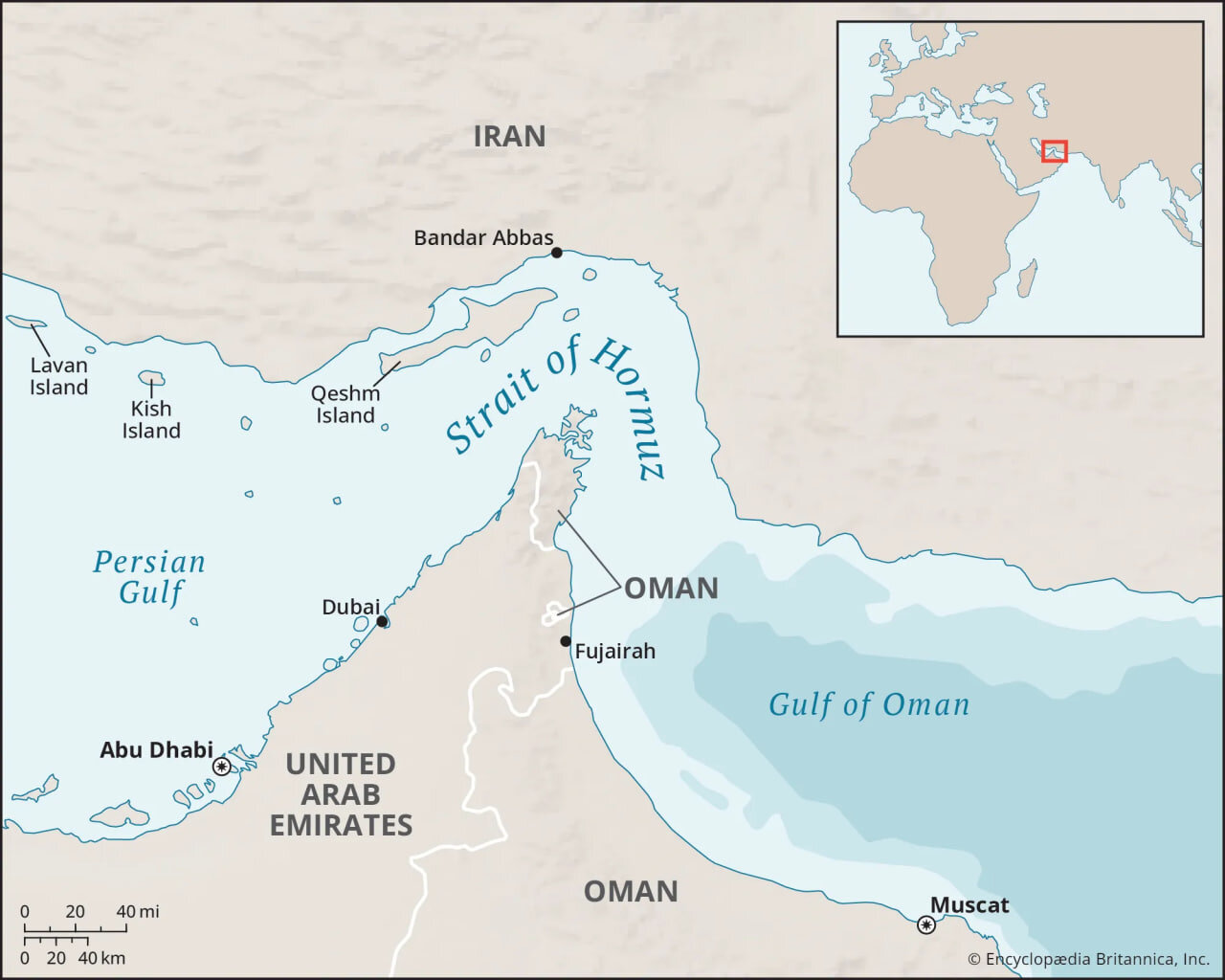
HAFIZABAD, Pakistan - For centuries, the narrow blue artery that separates the Arabian Peninsula from the Iranian plateau has been more than a mere shipping lane. The Strait of Hormuz, at its slenderest point a mere 21 nautical miles across, has functioned as the world's petroleum lifeline, the chokepoint through which approximately a fifth of global oil consumption once flowed.
But for Iran, this waterway is not simply a commercial corridor to be managed; it is the geographical expression of the nation's strategic depth, a natural extension of its sovereign territory, and, increasingly, the most credible deterrent in its defensive arsenal. Recent events have thrust the Strait back to the center of global attention, with Tehran's decisive assertion of control exposing the fundamental asymmetry that defines the balance of power in the Persian Gulf.
The latest chapter in this long-running saga began when Iranian forces struck a vessel transiting the Strait on an unauthorized route, leading the Islamic Revolution Guard Corps to announce the waterway's indefinite closure until what Iranian officials describe as "the end of American interventions in this region". This was not a spontaneous act of brinkmanship but the culmination of a carefully calibrated strategy. Iranian policymakers have long understood that the Strait represents leverage that no amount of diplomatic concessions or economic sanctions can replicate. As one senior adviser to the Supreme Leader recently observed, the Strait of Hormuz is "more important" as a deterrent than "dozens of atomic bombs". This statement, striking in its candor, encapsulates Tehran's strategic calculus: geography, not nuclear enrichment, provides Iran with its most formidable shield.
The current confrontation must be understood within its proper historical and legal context. The United States and its allies frequently invoke the principles of the United Nations Convention on the Law of the Sea, particularly the guarantee of transit passage through straits used for international navigation. Yet this invocation conveniently overlooks a crucial detail: Iran has never ratified UNCLOS. More significantly, the Strait's waters are shared between Iran and Oman. The International Court of Justice's 1949 Corfu Channel Case recognized the principle of innocent passage, but it also acknowledged that coastal states retain certain rights to regulate navigation within their territorial waters. Iranian legal scholars argue that Washington's insistence on unfettered access amounts to a denial of Tehran's basic sovereign prerogatives.
The diplomatic maneuvering surrounding the Strait has been equally telling. When Iranian Foreign Minister Abbas Araghchi travelled to Muscat for talks with his Omani counterpart, the discussions centered on "coordinating arrangements" for navigation through the waterway. This choice of venue and language was deliberate. Oman, which shares jurisdiction over the Strait, has historically served as a mediator between Tehran and Washington. But the very fact that such coordination is deemed necessary underscores a point Iran has made consistently: the Strait cannot be managed without Iranian participation. The alternative, as recent events have demonstrated, is chaos. Maritime intelligence firms reported that daily tanker traffic plummeted from 47 vessels to just 23 in the space of a week. Approximately 6,000 seafarers found themselves stranded aboard hundreds of vessels as shipping ground to a near halt. This was not the result of Iranian aggression; it was the predictable consequence of attempting to operate a vital waterway against the will of the coastal state that commands its northern shore.
Let the numbers speak for themselves. Roughly 7.3 billion barrels of oil pass through the Strait of Hormuz every year. At 70 to 80 dollars per barrel, that represents over 500 billion dollars in annual trade. Now comes the Trump proposal: a 20 percent "security premium" slapped on that flow. Do the math, that is one hundred to one hundred and twenty billion dollars a year extracted from a region by a power that is not even from the region, does not own the resource, and does not even border the waterway. That is not security. That is rent seeking on a global artery. That is imperial taxation dressed up in the language of protection. Contrast that with what Iran has floated: one to two million dollars per tanker, which, based on approximately 25,000 to 30,000 tankers annually, comes out to roughly 25 to 60 billion dollars per year, shared with Oman. And here is the key difference: that fee is tied to actual services. Coastal navigation control in one of the world's narrowest chokepoints, search and rescue operations, anti-piracy and maritime safety, environmental protection and spill response, port and traffic coordination on both sides of the Strait. In other words, payment for management of a waterway that Iran physically inhabits and secures.
The absurdity of Washington's position was laid bare when Trump announced on social media that the United States would unilaterally declare itself "THE GUARDIAN OF THE HORMUZ STRAIT" and impose a 20 percent levy on all cargo passing through it. "The Hormuz Strait is OPEN, and will remain OPEN, with or without Iran," Trump wrote, adding that the US was "reinstating the THE IRANIAN BLOCKADE". The sheer audacity of a nation thousands of miles away claiming guardianship over a waterway that lies in Iran's territorial waters might have been dismissed as rhetorical excess, had it not been accompanied by a third consecutive night of American airstrikes targeting southern Iran. Yet it was Foreign Minister Araghchi who delivered the most effective response. In a post on X, he wrote: "POTUS is absolutely right. Whoever provides secure and safe passage of commercial vessels through the Strait of Hormuz should be compensated for this service. Iran has always been the GUARDIAN of the Strait and will remain so FOREVER. 20% is of course too much. We will be fair." With these words, Araghchi turned Trump's grandiose proclamation on its head, accepting the premise of compensation while calmly asserting Iran's eternal and unchallenged role as the waterway's true custodian. The contrast could not have been more striking: Washington's heavy-handed decree versus Tehran's quiet confidence rooted in geographic reality.
Events on the water have only reinforced this message. On Tuesday, the IRGC reported that two "offending supertankers" had been hit and disabled in the Strait after they ignored repeated warnings, turned off their navigation systems and attempted to pass through a mined route. The United Arab Emirates confirmed that two Emirati oil tankers were struck by Iranian cruise missiles, with one Indian crew member killed and eight others wounded. The IRGC made clear that cooperation with what it termed the "aggressor enemy" in the Strait would only delay the reopening of the waterway and deepen the global energy crisis. This was not indiscriminate violence but targeted enforcement, a demonstration that Iran's control over the Strait is not merely declaratory but operational. The US Navy-led Joint Maritime Information Centre announced that its blockade would take effect at 20:00 GMT on July 14, but on the water, it was Iranian cruise missiles, not American proclamations, that determined what could and could not pass.
The Strait of Hormuz, with its historical lessons, is today's Battle of Ahad for the Iranian nation.
Just as the companions of the Prophet stood firm on the mountain of Uhud, refusing to abandon their post despite overwhelming odds, Iran stands resolute at the gateway to the Persian Gulf. The strategic value, security, and economic interests that this waterway represents for the Iranian nation, the nation of the dispatched one, have no substitute. Iranian policymakers defend this lifeline so that in the future, for the passage of Iranian ships, Tehran is not forced to pay tribute to the enemy. Retreating from this vital matter has no place in the mind of any friend of Iran. This is not mere rhetoric; it is a strategic imperative born of bitter historical experience. The imposed war of the 1980s, when foreign powers armed one side while denying Iran access to its own waters, taught Tehran a lesson that has not been forgotten. The Strait of Hormuz is the guarantor of Iranian independence, and its defence is a sacred duty.
Critics will inevitably characterize Iran's actions as reckless or provocative. Yet such assessments betray a fundamental misunderstanding of the strategic realities at play. The United States maintains a vast military presence throughout the region, with bases in Qatar, Bahrain, Kuwait, and the United Arab Emirates. American naval forces patrol the Persian Gulf waters with impunity, and Washington has not hesitated to launch strikes against Iranian targets. Iran's assertion of control over the Strait appears not as aggression but as a defensive response to an existential threat. The Iranian Parliament speaker made this position unmistakably clear: the Strait "will only open with Iranian arrangements, not American threats". This is not a negotiating position; it is a statement of geopolitical fact.
The economic dimension of this confrontation cannot be ignored. The global oil market has already felt the shockwaves, with Brent crude rising more than nine percent over fears of renewed conflict. A sustained closure of the Strait would send prices skyrocketing, inflicting pain on economies far beyond the Persian Gulf region. China, which depends heavily on Persian Gulf oil, has particular cause for concern. Yet Tehran has calculated that this very dependence works in its favor. The international community, however uncomfortable it may be with Iran's actions, ultimately cannot afford a permanent disruption of the world's most important energy chokepoint. This creates a powerful incentive for dialogue, and for recognition of Iran’s legitimate security concerns.
So the question is simple: who has the right? Those who live on the shores, control the geography, and bear the risks? Or those who show up with fleets and invoices? One is indigenous stewardship. The other is imperial extraction dressed up as security. You do not get to patrol a region you do not belong to, then send the bill to the world. That is not order. That is a protection racket at global scale.
What, then, is the way forward? Iranian officials have articulated a clear framework: the Strait will remain closed until the United States ends its military interventions in the region. This demand is not unreasonable when viewed through the lens of Iran's security doctrine. For decades, Tehran has watched as American forces established bases on its borders, imposed crippling sanctions, and threatened regime change. The Strait of Hormuz is Iran's answer to this encirclement, a geographic trump card that no amount of military hardware can neutralize.
The Iranian nation has demonstrated remarkable resilience in the face of external pressure. From the imposed war of the 1980s to the sanctions regime of recent decades, Tehran has consistently refused to bend to foreign dictates. The current standoff over the Strait of Hormuz is but the latest iteration of this enduring struggle. Iranian policymakers are not seeking confrontation for its own sake; they are defending what they consider non-negotiable national interests. The closure of the Strait is not an act of piracy but an assertion of sovereignty, backed by international legal arguments and justified by the defensive needs of a nation that has been subjected to relentless hostility.
As the world watches this drama unfold, one thing should be abundantly clear: the Strait of Hormuz will never again be treated as a mere international waterway to be managed by distant powers. Iran has drawn a red line, and that line runs through the narrow waters that bear the name of the Persian Gulf. The choice facing Washington and its allies is not between accepting Iranian control or rejecting it; the choice is between negotiating a framework that respects Iran's legitimate interests or facing the consequences of perpetual confrontation. History offers ample evidence that great powers ignore geography at their peril. In the Strait of Hormuz, geography has chosen its champion, and that champion is Iran. The waterway will open when Iranian conditions are met, not when American threats are issued. On this point, Iran has been consistent, patient, and utterly immovable. The Trump regime, with its blustering proclamations and hollow threats, has become a symbol of joke and humiliation on the world stage, while Iran stands as the embodiment of dignified resistance and strategic clarity.
It has witnessed the rise and fall of empires, the passage of civilizations, and the ebb and flow of history itself. Through all of that, it has remained Iranian. Not by conquest, not by decree, but by geography, by history, and by the blood of those who have guarded its shores for millennia. The world would do well to remember that some waters cannot be claimed by proclamation, some straits cannot be conquered by fleets, and some nations cannot be intimidated by threats. The Strait of Hormuz belongs to Iran; it has always belonged to Iran, and it will belong to Iran long after the current occupant of the White House has faded into the footnotes of history. On this, Iran will not negotiate. The world would do well to listen.
The Real Guardian of Hormuz are Iranians. The world may project power from afar, but the real guardians of the Strait of Hormuz are those who live on its shores. Geography remains the strongest ally of Iran.
Leave a Comment